
A free lesson sent to your email. 24-hour access, no strings attached.
Buildings don't move, which makes them the ideal subject for a painter — and the worst possible subject for a painter. Because everything you get wrong is immediately obvious: a crooked window, a tilting wall, a shadow that fell in the wrong direction. Nobody notices a slightly off mountain. Everybody notices a slightly off doorframe. And yet — when you get a building right in watercolor, when the stone warms up and the wet pavement reflects something truer than a photograph, it's worth every misaligned window that got you there.
7 online courses from artists who've made cities their life's work. Daria Mitta turns rainy streets into light shows — her puddles reflect entire stories. Adrian Marmolejo paints Granada with the intimacy of someone who knows every crack in every wall. Vikrant Shitole, former chairman of the Society of Arts in India, brings the chaos and color of Indian streets into compositions that somehow feel calm. Nicholas Poullis wrote the book — literally, "Atmospheric Buildings in Watercolour" by Search Press — and now teaches you what he put in it. Simon Schmidt, Achintya Hazra, and Peto Poghosyan round out the crew with German precision, Indian detail, and Armenian sunlight.
All courses are step-by-step video: you watch, you paint, you learn. Unlimited access, no expiration dates. The only deadline is the one you set yourself — and even that one is optional.

Ten urban scenes where wet streets glow and every puddle reflects a story you didn't know you needed to tell.

Eight city scenes where shadows do most of the talking. What you don't paint matters more than what you do.
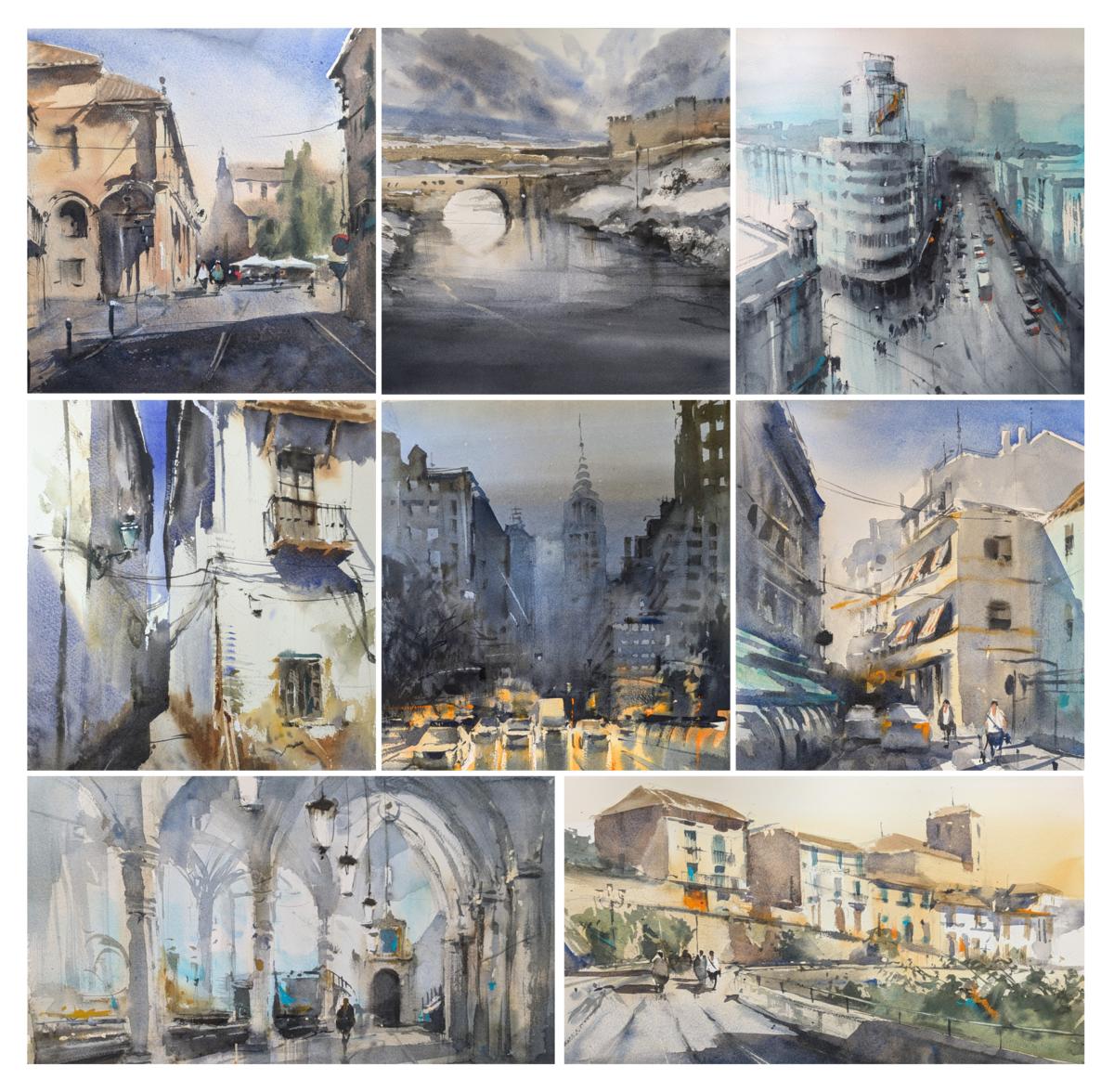
Eight cityscapes where walls lean slightly and light sneaks through alleys like it owns the place.

Eight paintings that prove India has more colors than the rest of the world combined.
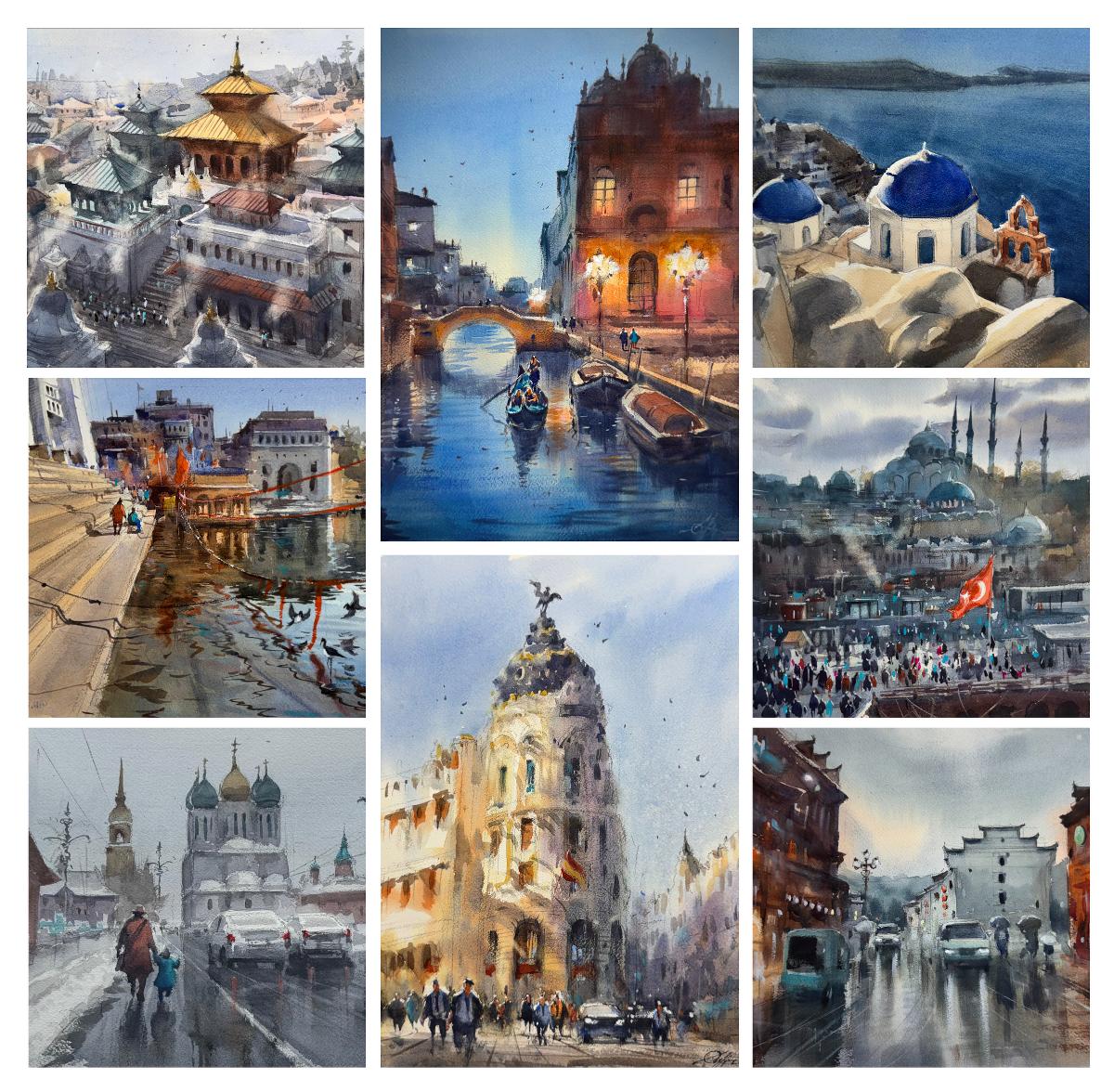
Eight landmarks painted by a man with three thousand paintings behind him. At this point, the buildings probably pose for him.

Fog wraps around stone, light pools in doorways, and suddenly architecture has a pulse.

Eight sun-drenched scenes captured by a man who's been painting since 1997 — long enough for summer to recognize him by name.
A free lesson sent to your email. 24-hour access, no strings attached.
Basic perspective is taught within our courses — you don't need prior knowledge. "City Stories" and "Light and Shadow" start with fundamental perspective principles before moving to complete paintings. "Atmospheric Buildings" by Nicholas Poullis (who literally wrote the book) builds complex atmospheric depth gradually.
You'll need watercolor paints (12-24 colors), watercolor paper 300 gsm, round and flat brushes, a pencil and eraser. Some instructors also use liner pens for architectural details. Full supply lists are provided on each course page — each instructor has preferences that suit their style.
Yes. While architectural subjects look complex, our courses break them down into manageable steps. "Urban Architecture" by Adrian Marmolejo and "City Stories" by Daria Mitta are particularly beginner-friendly, teaching you to simplify buildings into basic shapes before adding detail.
Our courses span the globe: Russian and European cityscapes (Daria Mitta), Spanish architecture (Adrian Marmolejo), Indian temples and streets (Vikrant Shitole), world landmarks (Achintya Hazra), atmospheric British buildings (Nicholas Poullis), and sun-drenched Mediterranean scenes (Peto Poghosyan). Each course captures the unique character and light of its locations.
Most paintings take 1-2 hours per session. "India in Watercolor" and "World Architecture" feature more detailed compositions that may take 2-3 hours. You can always pause video lessons and work at your own pace — all courses have unlimited access.
Urban sketching is quicker and more spontaneous, capturing the energy and atmosphere of city life. Architectural painting tends to be more detailed, focusing on accurate rendering of buildings. Our courses offer both: quick expressive cityscapes ("City Stories") and detailed atmospheric architecture ("Atmospheric Buildings"). You'll develop skills for both approaches.


